Alexander Karpekov
PhD Student in Computer Science. Data Scientist. Explorer.


PhD Student in Computer Science. Data Scientist. Explorer.
Hi there 👋🏻 My name is Alexander. I am working on my PhD in Computer Science at Georgia Tech, advised by Sonia Chernova and Thomas Plötz.
After spending a decade in the industry, working on breaking news discovery at Dataminr, and Search and YouTube Music recommendations at Google, I returned to academia to focus on Artificial Intelligence research. My interests span explainable AI, human-AI interaction, and data representation learning: from ML systems that make sense of everyday sensor data, to how robots should explain their behavior, to interactive tools that help people learn how AI works. I'm also drawn to impact evaluation with econometrics and large-scale A/B testing, and I love teaching.
Outside of school, I enjoy rock climbing (lead climbing) and snowboarding (calling Silverthorne, Colorado my second home), and I used to row with GT Crew. I like studying foreign languages and learning about new cultures. One day, I hope to learn how to play piano.
Past summer, I joined Georgia Tech faculty at the Technische Universität Berlin (TU Berlin) to assist with teaching of Introduction to AI (CS3600) and Computing Ethics (CS4001) classes.
Successfully completed PhD qualifiers at Georgia Tech in the Intelligent Systems track. See the presentation here.
Our VISAR paper, focusing on XAI for sensor-based activity recognition, has been accepted to the UbiComp '25 XAI workshop.
Teaching Update: Recently finished instructing 50 undergraduate students in CS3600: Introduction to AI at Georgia Tech.
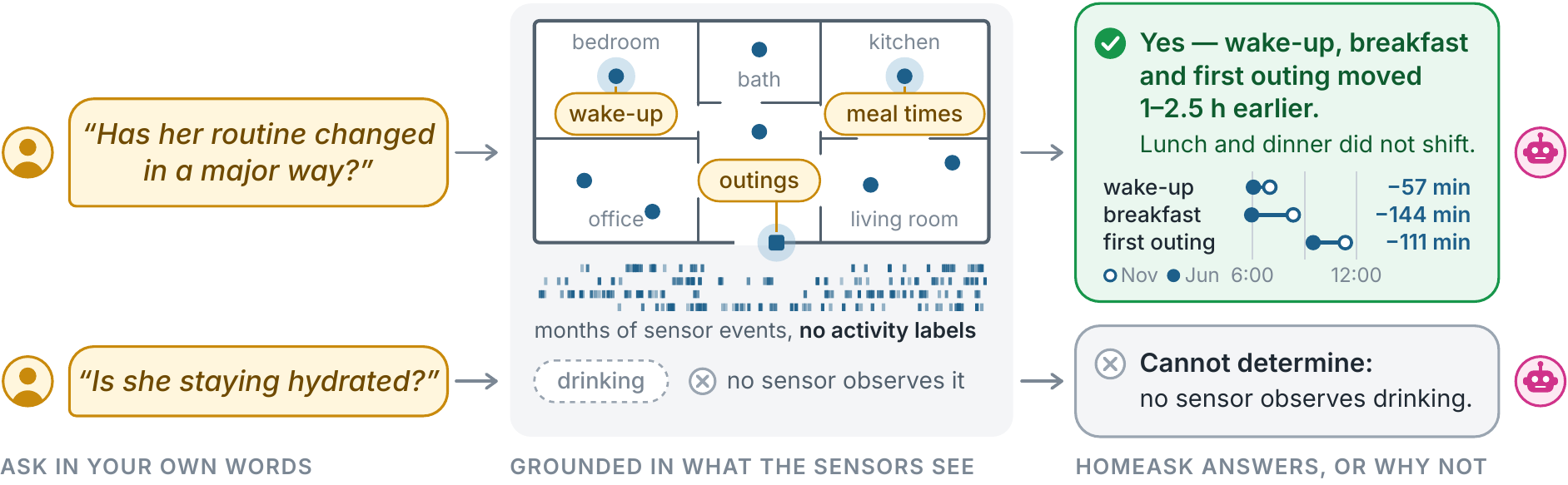
Unlike traditional Human Activity Recognition (HAR) approaches that map smart home activities to a closed set of predefined labels, we train a model that lets users ask about longitudinal patterns in natural language. Those descriptions stay tied to the underlying sensor sequences: the system retrieves and analyzes the matching sensor data, so the answers come from that data rather than from a language model alone.

In this paper we introduce DISCOVER, an active-learning method to identify fine-grained human activities from unlabeled smart home sensor data. DISCOVER combines self-supervised feature extraction and embedding clustering with a custom built visualization tool, which allows researchers to identify, label, and track human activities and changes over time.

An interactive visualization tool that teaches non-experts how Transformers work. It pairs an overview of the model's data flow with on-demand explanations that reveal the math step by step, and runs a live GPT-2 in the browser, so learners can try their own input and settings and watch next-token predictions in real time. A user study showed it improved understanding and engagement over more passive learning resources.

This project examines Guangdong's shifting economic growth using Night Lights data from satelites, focusing on development beyond the Pearl River Delta and the impact of 2008 government policies.